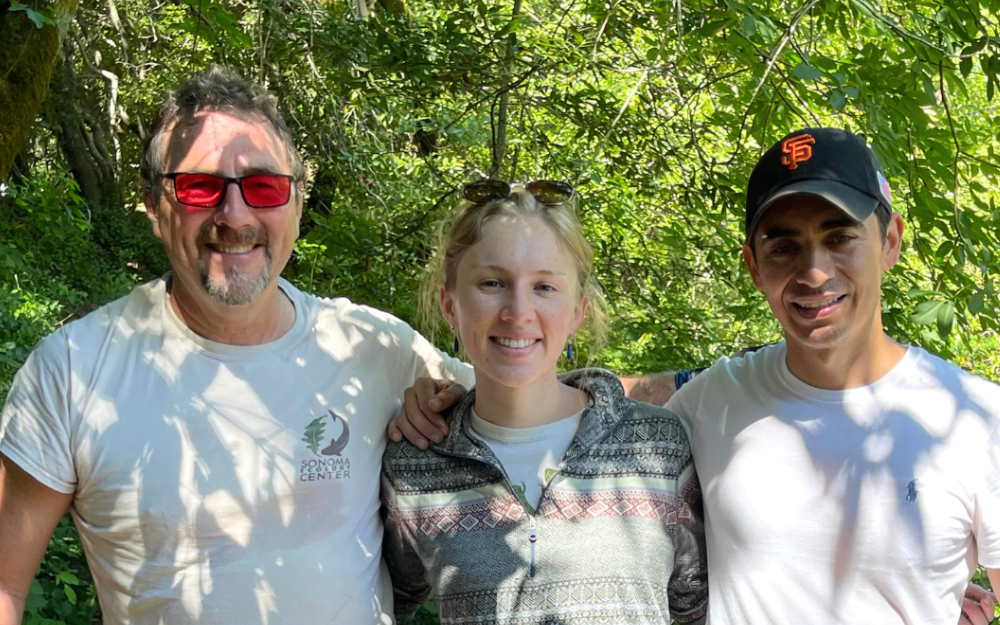
When he’s not leading watershed health monitoring, conducting sediment analysis, and penning research reports, Sonoma Ecology Center Senior Scientist and Research Program Manager Steven Lee (left) can be found rolling up his sleeves and removing debris from our local creeks, like in the above photo taken at a June 2025 Creek Cleanup Day organized by Sonoma Ecology Center, Homeless Action Sonoma (HAS), and partners. Our next community creek cleanup is November 15—sign up here.
With the recent close of the 2025 “water year,” which runs annually from October 1 through September 30, we’re pleased to share a precipitation update from Sonoma Ecology Center Senior Scientist, Steven Lee (written on September 30, 2025). Steven reflects on last year’s rainfall, the state of Sonoma’s watershed, and what we can anticipate as our current rainy season gets underway!
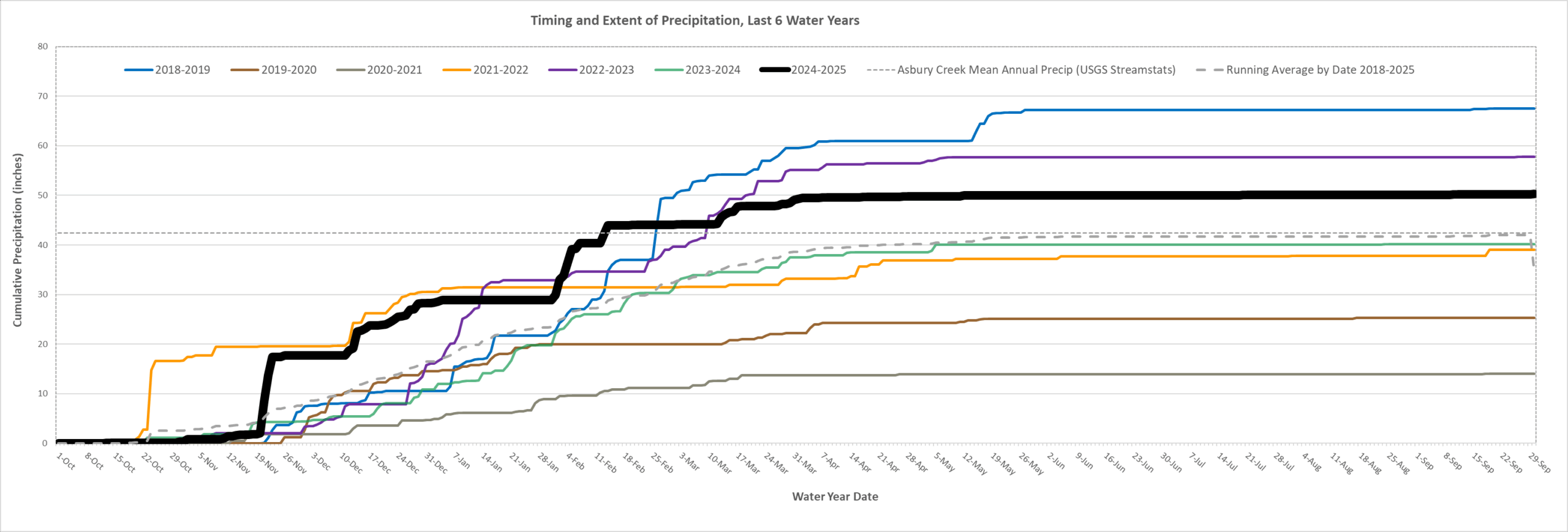
 The quarter inch of bonus rain that fell in September brought us to a total of 50.33 inches for the water year here at our (Lee family) farm on the flank of Sonoma Mountain in Glen Ellen—a better-than-average year, considering the local average is 42.4 inches (see the black line in the cumulative precipitation graph below which has data for the past seven years). The significant storm periods in late November 2024 and early February 2025 were the key contributors to this total. The overall rainfall, combined with good infiltration to groundwater during the lighter, intermittent storms, helped keep Sonoma Creek and its major tributaries flowing throughout the summer—supported further by the relatively cool spell we experienced from late June through July. If our creek species could smile, most would be doing so now. In the coming weeks, flows will likely improve even more as trees lose their leaves and evapotranspiration along the creek corridors continues to decrease.
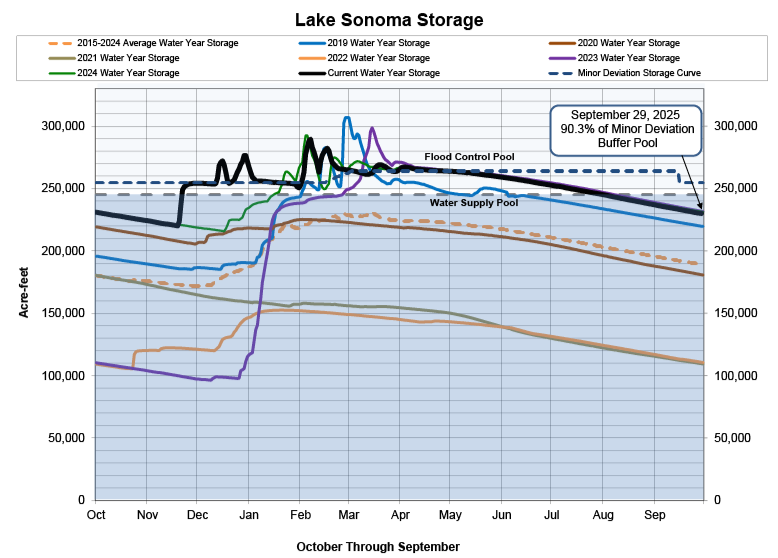
See also the graph showing water supply levels in Lake Sonoma, which is the main source of water for the County. This graph covers the past seven years and uses the same color scheme found in the precipitation graph. Given the long dry season we just got through, we are in a fantastic place with our water supply due to favorable water conservation measures including FIRO (Forecast-Informed Reservoir Operations) which allows for more judicious management of water supply levels above the level reserved for emergency flood capacity. Regardless of the year we are about to have (and I predict it will be a lower than average year), we are almost certain to begin next summer with a full Lake Sonoma.
Why do I think we have a lower than average precipitation year ahead of us? It’s an educated guess, and one I’d be happy to be wrong about, but current indicators point toward developing La Niña conditions, which typically result in a cooler, wetter Pacific Northwest and a warmer, drier Southern California. Our region sits in between the two, meaning outcomes can swing either way. But if the familiar high-pressure dome persists off our coast, as it has in past years, the jet stream could stay pushed north—diverting storms away from us once again. Before 2014, a massive pool of warm water known as “the blob” formed off the West Coast, triggering seastar wasting disease and the massive loss of kelp off our NorCal coast which resulted in starving abalone and community destabilizing sea urchin barrens. A similar warm blob has been found off the coast of Washington and British Columbia in recent weeks. The expectation is that it might break down with the onset of upwelling once winter storms start rolling in, but there is a chance it could linger and help propagate the offshore high pressure dome that so often keeps us dry. We’ll see! And in the meantime, happy 2026…water year 2026 that is!
-Steven Lee
In addition to Sonoma Ecology Center’s Research Team’s year-round work monitoring Sonoma Valley’s watershed health, and our Restoration Team’s various projects to restore and enhance creek habitats, conducting seasonal creek cleanups is a critical part of stewarding our local waterways and one that YOU can directly support.
On November 15, Sonoma Ecology Center is joining forces across the Sonoma Creek Watershed for one last cleanup push before the winter rains roll in. In partnership with Rotary Club of Sonoma Valley, Sonoma County Regional Parks, Homeless Action Sonoma, and local HOA affiliates, we’re assembling volunteer teams to tackle creek cleanups across the Valley at Maxwell Regional Park, Leveroni Bridge, Agua Caliente Bridge, and Boyes Boulevard Bridge. Just a few hours of your time can make a big difference for the health of our watershed—click the button below to sign up!