
Stewarding
Land & Water
Guided by decades of research and watershed knowledge, our restoration work is designed to create multiple benefits at once. Improving habitat for wildlife, reducing wildfire risk, strengthening creek health, supporting biodiversity, storing carbon, and helping Sonoma Valley adapt to a changing climate are the multiple benefits of our science-based approach.
Shortcuts
Upper Sonoma Creek Restoration Vision
A Vision for Water Resource Management and Climate Resilience within the Open Spaces of the Sonoma Developmental Center (SDC)
Multiple Benefits of Restoration
Biodiversity and Wildlife Habitat
Fire Resilience
Creek Health and Water Quality
What is the Sonoma Creek Watershed?
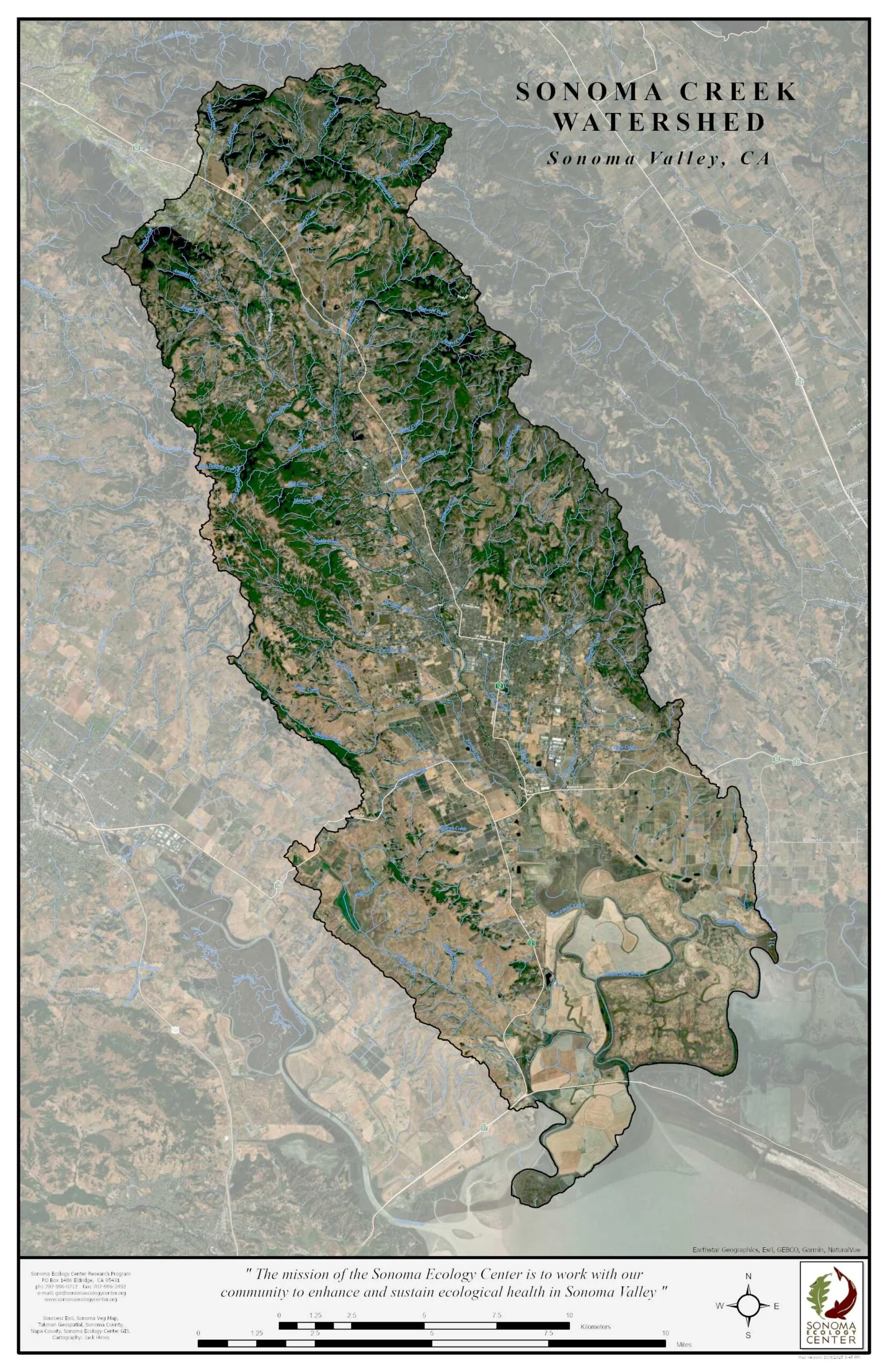
A watershed is all the land where rainfall and runoff flow downhill into the same creek system. The Sonoma Creek Watershed is Sonoma Valley’s connected land and water system. From the headwaters at Sugarloaf Ridge State Park, water flows through the forests, hillsides, neighborhoods, farms, and open spaces of the valley before reaching San Pablo Bay. Everything that happens across this landscape affects the health of the Sonoma Creek Watershed.
What Makes a Healthy Watershed?
A healthy watershed depends on many interconnected systems working together, including creeks and wetlands, groundwater, soils, forests and grasslands, native plants and wildlife, and the built environments where people live and work. These systems influence how water moves through the landscape, how habitats function, how fire behaves, and how the Valley responds to drought, flooding, and climate change.
Understanding these relationships through research and data collection helps guide our decisions about land management, restoration, water, habitat, and fire resilience across the Valley.
Research and Monitoring
Sonoma Ecology Center maintains the only long-term watershed health monitoring program focused specifically on Sonoma Valley. Our research helps track ecological conditions across the watershed and guides decisions about restoration, water habitat, and climate resilience.
-
Over the years, Sonoma Ecology Center has spent a lot of time and effort learning about the history of human development in the watershed in an effort to understand what the historical hydrological and ecological conditions were so that we could determine what should be done to improve and restore watershed conditions. Our ever-growing Historical Ecology Archive will be a valuable resource to local water resource managers for decades to come.
-
This program by Sonoma Ecology Center and Trout Unlimited is designed to monitor streamflow in Sonoma Valley, then create a plan with local landowners to enhance streamflows in the upper Sonoma Creek Watershed. The resulting projects will support aquatic wildlife while improving our own water supply.
-
Sonoma Ecology Center created and maintains the only watershed health monitoring effort in Sonoma Valley. Following strict standards, we monitor sediment pollution levels, streamflow, aquatic insects, fisheries, temperature, and other measures of watershed health. We have been the only locally based nonprofit to produce sediment pollution data and analysis thorough enough that major water quality regulations are based on it.
-
Sonoma Ecology Center has done a tremendous amount of species and habitat monitoring in the Sonoma Creek watershed to understand which portions of the creek and its tributaries are the most critical to our remaining, threatened steelhead population and also the endangered California freshwater shrimp that live here. Funding for this sort of research has been severely limited in recent years, but the SEC Research Program continues to find ways to find and document the presence and abundance of these species wherever it can, including documenting the return of Chinook Salmon to the watershed. Recently we have been using snorkel surveys to monitor key sections of the creek to see how the populations of these critical species change over time, including in response to drought conditions. Underwater cameras we take with us have led to some incredible imagery of these species in their natural environment. Sonoma Ecology Center has also been instrumental in helping to steward and protect the endangered Kenwood Marsh Checkerbloom.
-
Over the years, Sonoma Ecology Center has made several large pushes to promote restoration projects along Sonoma Creek to address barriers to successful salmonid spawning and rearing and to improve habitat conditions for these species. Back in the early 2000s a series of large woody debris (LWD) installations were done to provide improved microhabitats for fish and other species. More recently our Upper Sonoma Creek Restoration Vision effort identified 22 locations between Glen Ellen and Kenwood where restoration and water retention/infiltration projects could be done to improve conditions for salmonids. Sonoma Ecology Center has already completed its first fisheries restoration demonstration project at Morton’s Warm Springs, and has a pipeline of additional restoration project as various stages in the planning process.
-
Housed within the SEC Research Program is our GIS (Geographic Information Systems) wing which has created a collection of wonderful watershed maps and has worked throughout the years with a number of regional partners to produce park and land management maps and provided the spatial analyses and cartography to help local landowners and watershed managers better steward the land, water and species within an beyond Sonoma Valley.
BUY A MAP OF THE SONOMA CREEK WATERSHED
Restoration Planning
Many of the most important restoration efforts begin years before construction starts. Informed by research findings, these planning studies identify priorities, find the funding, secure the permitting, and build the partnerships needed to restore land, water, and habitat at the watershed scale.
-
Sonoma Ecology Center’s goal with the Upper Sonoma Creek Restoration Vision is to work with the Sonoma Creek community to identify and design ways to improve steelhead/salmonid habitat through engaging landowners in voluntary restoration.
As part of our work in implementing the Upper Sonoma Creek Restoration Vision, we published a report that creates a vision for the upper reaches of Sonoma Creek—with key input from the community—for how to improve habitat for steelhead, reduce bank erosion and loss of property, and improve water quality and riparian habitat and all the biodiversity that it supports.
Our first step in creating this vision was to meet with people living along the creek between Madrone Road and Adobe Canyon through a series of community meetings, asking creekside residents and land managers their main concerns (erosion topped the list) as well as their thoughts on creek restoration and riparian management. We also collected input through other outreach including an online Creek Survey.
The project research included a review of previous studies of the watershed, landscape analysis of the creek topography, and field visits to evaluate and prioritize potential locations for restoration actions that will address both the causes and the symptoms of salmonid decline. Through the combination of landowner outreach and technical research, the project identified 20 sites with restoration potential and developed conceptual plans for 16 sites based on landowner input and interest. This Restoration Vision represents the project team’s synthesis of previous studies, historic and existing conditions, and restoration opportunities.
The report was researched, written and designed by Sonoma Ecology Center and Environmental Science Associates, with funding from the California Department of Fish and Wildlife and with immeasurable help from community members.
Project Goals
The primary goal of the project is to improve spawning conditions for adult steelhead along with winter and summer rearing habitat for juvenile steelhead. While this may appear to be a narrow goal, steelhead can be thought of as an “umbrella” species: restoring spawning and rearing habitat for juvenile steelhead would entail restoring a wide range of interrelated species and habitats, from the gravel-dwelling invertebrates on which steelhead and other aquatic animals feed to the trees that shade them. Reducing bank incision and fine sediment erosion that buries gravels is critical to restoring steelhead habitat.
Several secondary objectives will help us meet the primary goal. These include:
Slow Water: create places where runoff can be retained before entering Sonoma Creek, to reduce flooding, increase groundwater infiltration in the winter and create more sustained summer baseflows in the creek.
Improve Water Quality: take measures to reduce water temperature, contaminants, pathogens, and fine sediment.
Reduce Bank Erosion: restore natural sediment dynamics that promote the deposition of coarse sediment (for spawning and supporting the invertebrates that salmonids eat) while reducing erosion that generates fine sediment, burying spawning gravel.
Improve Riparian Habitat: restore native vegetation, expand the riparian corridor, restore seasonal wetlands.
Background
Historically, upper Sonoma Creek was a vibrant river corridor bordered by many seasonal and perennial wetlands that supported significant runs of steelhead, Chinook salmon and Coho salmon. Today, there are only small runs of steelhead and Chinook salmon. Investigations into the decline of the salmonid runs led to Sonoma Creek being listed as impaired due to excessive fine sediment in 1996, and the 2006 Limiting Factors Analysis (LFA) identified channel erosion as the main source of fine sediment. Channel erosion was also found to be degrading the in-channel habitat for salmonid spawning and rearing, while fish migration barriers and lack of cold water during the summer were found to be impacting summer rearing by steelhead. The LFA identified the need to counter the impacts of development on the ecosystem by restoring degraded summer and winter rearing habitat by redeveloping channel complexity and instream shelter. The Upper Sonoma Creek Habitat Restoration Project is the planning phase of a project to protect and restore habitat for steelhead and Chinook salmon.
Questions or suggestions? Contact us at creek@sonomaecologycenter.org.
-
In 2018 SEC secured funding from the California State Coastal Conservancy to study, restore, and plan for Sonoma Creek and its riparian areas as they run through the Sonoma Developmental Center (SDC) and the surrounding Sonoma Valley Wildlife Corridor. This report identifies opportunities to retain and infiltrate stormwater on SDC's open space lands, improving dry season streamflow for steelhead and other sensitive species while addressing chronic erosion sites contributing sediment to the creek. Drawing on nearly three decades of SEC's work in this landscape, the plan outlines ten water retention opportunities and eight erosion sites across the property, offering a roadmap for future stewardship as SDC transitions to new ownership.
How Research Informs Restoration
Research and monitoring help us understand how the Sonoma Creek watershed is functioning over time and where systems are under stress. By tracking streamflow, water quality, erosion, fish populations, vegetation, and other ecological indicators, we can better understand how drought, wildfire, development, and climate change are affecting Sonoma Valley.
This information helps guide restoration projects, land stewardship, and policy decisions across Sonoma Valley and the wider region.
Because these systems are connected, research often reveals opportunities for projects that provide multiple benefits at once, such as improving habitat, reducing wildfire risk, stabilizing streambanks, supporting groundwater recharge, and improving water quality.
Multiple Benefits of Our Restoration Work
Sonoma Ecology Center’s Restoration Department stewards and restores more than 5,000 acres of public and private land across Sonoma Valley. Guided by our research, monitoring, and ecological best practices, our team works to improve watershed function through land management strategies that create multiple benefits at once, including healthier creek systems, reduced wildfire risk, improved habitat, increased biodiversity, and more resilient landscapes.
-
Our restoration work improves and reconnects habitat by managing invasive species, restoring native vegetation, improving creek corridors, and supporting the natural processes that sustain biodiversity across Sonoma Valley.
Much of our work focused on “umbrella” species such as steelhead: restoring spawning and rearing habitat for juvenile steelhead would entail restoring a wide range of interrelated species and habitats, from the gravel-dwelling invertebrates on which steelhead and other aquatic animals feed to the trees that shade them.
-
Ecologically informed fuel reduction can reduce wildfire risk while also improving the health of forests, woodlands, and home landscapes. We manage vegetation with an understanding of how fire naturally functions in Sonoma Valley, helping create both wildlands and home landscapes that are better prepared for future fires while supporting wildlife and reducing water use.
-
Restoring streambanks, reducing erosion, managing vegetation, and improving habitat can reduce sediment and pollution, support cooler and healthier creek conditions, and improve habitat for steelhead and other aquatic species.
-
Watersheds need to capture water in the rainy season so that it’s available for people and nature in the dry season. Our work slows down runoff and encourages rain to soak into the ground, providing trees with water and aquifers with recharge. These strategies emulate beavers to make watersheds more resilient to both drought and flood.
How can people, land, water, and wildlife thrive in a fire-adapted landscape? Watch our Fire Resiliency video on how we keep people safer while supporting our environment.
Directed by Conor Hagen. Filmed while smoke from the LNU Lightning Complex fire was impacting Sonoma Valley
Lands We’ve Helped Protect
Sonoma Ecology Center has a long track record of successfully protecting Sonoma Valley’s open spaces. We do this by identifying opportunities for preservation, then working with partners to find common ground, both figuratively and literally. To date we have helped protect more than 5,000 acres of Sonoma Valley land by forming new preserves, adding land to existing state or regional parks, and guaranteeing the ongoing protection of key pieces of land.
-
When the state threatened to close Sugarloaf Ridge State Park, a 4,000-acre state park and local treasure, Sonoma Ecology Center pulled together a team of skilled nonprofits to create Team Sugarloaf, which reopened the park in 2012 and assumed responsibility for this local landmark.
Since 2012, Sugarloaf Ridge State Park has been operated by Team Sugarloaf after successfully negotiating the re-opening of the park after closure in 2011 due to a State funding crisis. Team Sugarloaf began as a coalition of five nonprofit partners spearheaded by Sonoma Ecology Center. Today, Sugarloaf Ridge State Park is operated solely by Sonoma Ecology Center. The Robert Ferguson Observatory, located at Sugarloaf Ridge State Park, is operated by Valley of the Moon Observatory Association.
-
Sonoma Ecology Center contracts with the City of Sonoma to operate Sonoma Garden Park, a 6.1-acre working farm, model of sustainable agriculture, center of education, and vibrant gathering place located at 19996 7th St. East in Sonoma. In the nearly 30 years we’ve operated this public park, it has become one of the community’s greatest resources. Sonoma Garden Park is a lush garden where many of our classes, camps and educational workshops take place.
-
The former Sonoma Developmental Center, closed by the state in 2019, features a large campus surrounded by more than 700 acres of vital open space. It is the also the longtime home of Sonoma Ecology Center, which keeps offices alongside Sonoma Creek near the historic main campus building. Since the beginning of the closure process, which. was a complex ongoing discussion involving multiple agencies and stakeholders, Sonoma Ecology Center has had a seat at the table to ensure protection of its invaluable open space along with the overall well-being of the SDC/Eldridge community.
-
In 1995, a volunteer named Christy Vreeland approached us with an idea: create a habitat corridor in Sonoma Valley connecting Sonoma Mountain with the Mayacamas, keeping its ecosystem healthy and diverse. Sonoma Ecology Center took Vreeland’s idea to local agencies and districts, and a Sonoma Valley habitat corridor began to take shape: local property owners worked with preservation organizations to place easements on their land, fences were removed, passageways cleared, and habitat restored.
Today, more than 5,000 acres of what is now called the Sonoma Valley Wildlife Corridor have been protected thanks to one person’s vision. Approximately five miles long and 3/4 miles wide, the corridor encompasses a wide array of habitats including conifer forests, chaparral, wetlands, grasslands, riparian forests, blue oak savanna, and two reservoirs, and supports a rich collection of fauna including threatened species such as steelhead trout and northern spotted owl, as well as wide-ranging animals such as bobcats and black bears.
-
Sonoma Overlook Trail is a three-mile walking path set into a hillside backdrop overlooking the City of Sonoma. A diverse array of native plants and animals grace this public trail, and the meadow at its top features spectacular views of Montini Open Space Preserve, the City of Sonoma, Sonoma Valley and the Bay Area beyond. In partnership with the City of Sonoma and Sonoma Ecology Center, Sonoma Overlook Trail Stewards now have the lead responsibility for stewardship of the trail. Trained docents knowledgeable about the trail’s flora, fauna, and history are available to guide private groups.
-
Established by Ag + Open Space in 2005, this 98-acre property abutting the City of Sonoma’s northern slopes was transferred to the city in 2011. Sonoma Ecology Center helped guide the transfer, and now partners with the city in managing and restoring the land, which features oak woodlands, seasonal streams and a variety of native flora and fauna.
-
Van Hoosear is a stunning 163-acre privately owned preserve that is is permanently protected under a conservation easement. Sonoma Ecology Center manages the preserve with the landowner and leads public walks each spring through its spectacular wildflower displays. Van Hoosear is home to more than 250 species of common and rare wildflowers and native grasses, and a favorite spot for our outings.
-
Formerly a neglected ditch running through the City of Sonoma, Nathanson Creek Preserve is now a three-quarter-mile greenway with trails and a native plant demonstration garden. This city jewel in the heart of downtown is located alongside two schools, both of which use it as a living outdoor classroom. Local gardening enthusiasts volunteer their time to keep the demonstration garden, located at 2nd St. East and MacArthur, flourishing.
-
Sonoma Ecology Center has played a critical role in many more preservation victories, finding solutions with landowners and agencies that resulted in protecting the following open spaces, among others. All are important parts of Sonoma Valley that residents and visitors cherish:
Calabazas Creek Open Space Preserve
600-acre addition to Jack London State Historic Park
Curreri addition to Sonoma Valley Regional Park
Stuart Creek Run habitat preserve
Land Services For Hire
Our Restoration Department has more than 25 years of successful experience performing natural resource management projects.
We know how to plan for and accomplish management goals in sensitive habitats with effective, high-quality and affordable methods. Our depth of experience assures quality control on work we carry out, and allows us to incorporate adaptive management techniques that ensure project goals are met in a timely and efficient manner. We utilize smaller crews with technical expertise to maximize budgets and get projects done to a high level of quality.
Our service area focuses on Sonoma Valley and extends to the surrounding regions of Northern California. We have experience working in many of Northern California’s natural habitats, including dunes, coastal scrub, grasslands, chaparral, oak woodlands, mixed evergreen forest, redwood forest, wetlands, and riparian ecosystems. Our project team has the ecological knowledge, as well as specialized equipment and capacity, to carry out all of the requested services.
Capabilities & Services
Full service fish and wildlife habitat restoration for landowners (weed control, erosion control, bank stabilization, native plant installation, irrigation, maintenance)
Native plant restoration
Invasive non-native weed eradication: French broom, Himalayan blackberry, vinca, and English ivy.
Native plant production – specializing in local/ watershed-sourced genotypes (seed collection/storage, propagation, growing/transplanting)
Fish Barrier removal
Stormwater management/low impact design (Erosion control, sediment filtration, etc.)
Storm drain retrofitting (energy dissipater, detention basin, geotextile fabric installation).
Bioengineering (willow revetments, willow mattresses, vegetated swales, etc)
Erosion control (plants, geotextile, biodegradable fabric/ wattles, etc.)
Land management (full service – Habitat restoration and management)
Flood Management
Biochar Demonstrations and Biochar Kiln Burns
We assist owners with lands of all sizes. To schedule a consultation, please fill out the Land Services Request Intake Form and email pictures of your property to restoration@sonomaecologycenter.org.
Stewardship of Public Lands
Sonoma Ecology Center’s Restoration team stewards some of Sonoma Valley’s most visited and ecologically important public lands. Across these landscapes, our team manages trails, habitat restoration, invasive species removal, creek health, fire fuels reduction, and long-term ecological stewardship to support both public access and watershed health.
-
In collaboration with the City of Sonoma, Sonoma Ecology Center is responsible for the management and maintenance of both of these cherished open space preserves, located on the city’s northern border. Our trained Restoration professionals conduct trail work, hazardous tree assessment, invasive plant control, and habitat restoration at both preserves, and help mitigate fire danger at Montini through invasive weed management, targeted mowing and by hiring grazing subcontractors. Restoration crew members also guide volunteers in planting, weeding and other volunteer events at the preserves.
-
Sonoma Creek is one of the most important streams in the Bay Area due to the habitat it provides for native fish and wildlife. For two decades, Sonoma Ecology Center’s Restoration Department has serviced and improved Sonoma Creek by removing barriers to native fish migration, improving fish habitat, keeping stream banks and beds from washing away, slowing and filtering stormwater, invasive plant control, and planting native plants. We work constantly with creekside landowners and in partnership with Sonoma Water, the Wildlife Conservation Board, the California Coastal Conservancy and Environmental Science Associates to further the stewardship of Sonoma Creek.
-
Since 2012, Sugarloaf Ridge State Park has been operated by Team Sugarloaf after successfully negotiating the re-opening of the park after closure in 2011 due to a State funding crisis. Team Sugarloaf began as a coalition of five nonprofit partners spearheaded by Sonoma Ecology Center. Today, Sugarloaf Ridge State Park is operated solely by Sonoma Ecology Center. The Robert Ferguson Observatory, located at Sugarloaf Ridge State Park, is operated by Valley of the Moon Observatory Association.
Sugarloaf Ridge State Park was closed in December 2011 for the first time in its 48-year history due to the State of California’s budget problems. Eager to reopen the precious 3,900-acre gem, Team Sugarloaf worked with the State Parks to develop an operating plan that would enable it to re-open and become fully available to the public. Under the agreement, the State maintains ownership of the park while Team Sugarloaf manages operations.
Another event that greatly impacted Sugarloaf Ridge State Park was the Tubbs Fire back in Fall 2017. The park was closed for months following due to how the fire burned 80 percent of the 3,300-acre park. Since the fire happened, staff have removed over 60 downed trees, repaired burned-out steps, and installed new retaining walls. A big risk following the fire was the chances of landslides happening due to the lack of rain. Any bit of rain would impact the land.
The following two months after the fire everything was black. It was hard to recognize any sign of life. You would be able to see the fire line halfway up the hike to the top of Bald Mountain. Even today, the scar from the fire is still very evident. To read the full article from The Bohemian on the 2017 fires, please click here.
In 2020, SRSP once again was struck by fire. Thanks to our dedicated volunteers, we finished most of the fire repairs needed after the 2020 Glass Fire on the 75% of the park that burned, and reopened the McCormick Addition and Goodspeed Trail. SRSP day use and camping has significantly increased since the reopening, and the Visitor Center is in the process of receiving a more user-friendly makeover. We have a five-year operating agreement with the State of California.
While Sugarloaf is a California State Park, we do not receive operating support from the State. It is our supporters, visitors, and members that keep Sugarloaf Ridge State Park open to the public.
-
Sonoma Garden Park was originally the property of Pauline Bond, a Sonoma schoolteacher who gave the land to the City of Sonoma in 1977 with the agreement that it remains a public park. In 1993, Sonoma Ecology Center entered into an agreement with the City of Sonoma to take over regular operation of the 6.1 acre park, and began to grow it from a bare lot to its current lush grounds of orchards, gardens and public gathering places.
Improvements were made over time, including a Straw Bale Barn built in 1994, a Native Plant Nursery built in 2012, and Low Impact Design features added in 2017. In 2019, the City of Sonoma approved our new Master Plan Update, guaranteeing that this beloved park will continue to be an essential community gathering place for many years to come.
Online Resources for Better Land Management
Through partnerships with regional organizations and experts, Sonoma Ecology Center has developed online resources that help landowners and land stewards care for their properties using science-based, ecologically informed practices.
-
Tending the Land for Fire Resilience in Sonoma County is a website guide for anyone who plays a role in stewarding land in Sonoma County to achieve a variety of goals, from fire resilience to conserving water, enhancing wildlife habitat, and more.
→ Visit
-
The Resilient Landscapes Coalition provides practical information to homeowners, landscape professionals, and defensible space inspectors about implementing defensible and resilient landscapes in the 0-100 foot zone around the home, based on the best scientific research and gardening expertise.
→ Visit
Prescribed Burns at Van Hoosear Wildflower Preserve
Our biologists and restoration ecologists wrote the management plans for this 163-acre privately owned preserve, mapping natural resources as well as locations of sensitive and threatened species. Together with the landowner, Sonoma Ecology Center protects the preserve’s streams and species while managing invasive species. A newer stewardship tool we use at the preserve is prescribed fire.